
What does raw honey mean? In plain terms, raw honey is honey that moves from the comb to the jar without pasteurization or fine filtration. The beekeeper extracts it, strains out wax and bee bits, lets it settle… and bottles it. Nothing is added, and everything worth keeping stays in.
That sounds straightforward. In the US, the word “raw” on a label isn’t legally defined or checked by any federal agency. So two jars carrying the same word on the front can hold very different honey.
This guide covers how raw honey is made, how it differs from processed honey, what the label really tells you, and how to spot the real thing.
What Is Considered Raw Honey?
Raw honey is honey kept as close as possible to its state inside the hive. That’s the working definition of raw honey most beekeepers rely on.
The Working Definition
The National Honey Board, which operates under USDA oversight, describes raw honey as honey in the state it exists in the hive, or as obtained through extraction, settling, or straining with no added heat. The board itself notes this carries no legal force. Even so, it’s the closest thing the US trade has to a shared rule.
Read it closely, and three conditions stand out:
- Extraction only: honey is spun or pressed from the comb.
- Straining, not filtering: a coarse mesh holds back wax and debris while letting pollen pass through.
- No added heat: the honey is never warmed beyond what the hive itself does.
Hive Temperature Is the Real Line
Bees keep the brood nest at around 93 to 95°F (about 34 to 35°C). Honey in the comb holds roughly that same warmth all summer long. So most beekeepers treat hive temperature as the ceiling… go past it, and you’ve altered the honey. Some producers allow up to about 118°F to help it pour on bottling day.
Raw Means Finished by Bees
The word “raw” often brings to mind raw milk or raw meat. Honey is different. It’s a finished food, and the real raw honey meaning is more specific than most people assume. It’s complete the moment bees cap the cell, after they’ve fanned out extra water and sealed it in wax. So here’s raw honey explained in one line: the bees finished the job, and nobody redid it in a factory.
How Raw Honey Is Made: From Frame to Jar
Honey production methods differ somewhat between farms. But raw honey processing stays short on purpose, because fewer steps mean less is lost.
- Pulling the frames. Frames come out once most cells are capped with wax. Capped honey is ripe, with its water down to around 17 to 18 percent, so it won’t ferment.
- Uncapping. A heated knife or a fork slices off the thin wax caps. (The knife warms the wax, not the honey beneath it.)
- Extraction. Frames spin in a centrifugal extractor, which flings honey out of the cells. Smaller keepers sometimes use a simple crush-and-drain method as a gentle alternative.
- Straining for clarity. Honey passes through a mesh or cloth to catch wax flakes, bee parts, and chunks of propolis.
- Settling. It rests in a tank for a day or two. Over that time, trapped air and stray wax particles float upward and are removed from the surface.
- Bottling. It’s poured into jars at room temperature. That’s the whole process.
Straining vs. Filtration: Where the Line Sits
This is where most labels get fuzzy. Straining relies on a coarse screen, wide enough for pollen grains and tiny wax specks to slip through.
Honey filtration in large plants works differently. They warm the honey so it flows, then force it under pressure through very fine filters. That removes nearly all the pollen.
A simple way to remember it: straining takes out what you’d notice in your mouth. Filtering takes out what you’d need a microscope to see.
Raw Versus Processed Honey
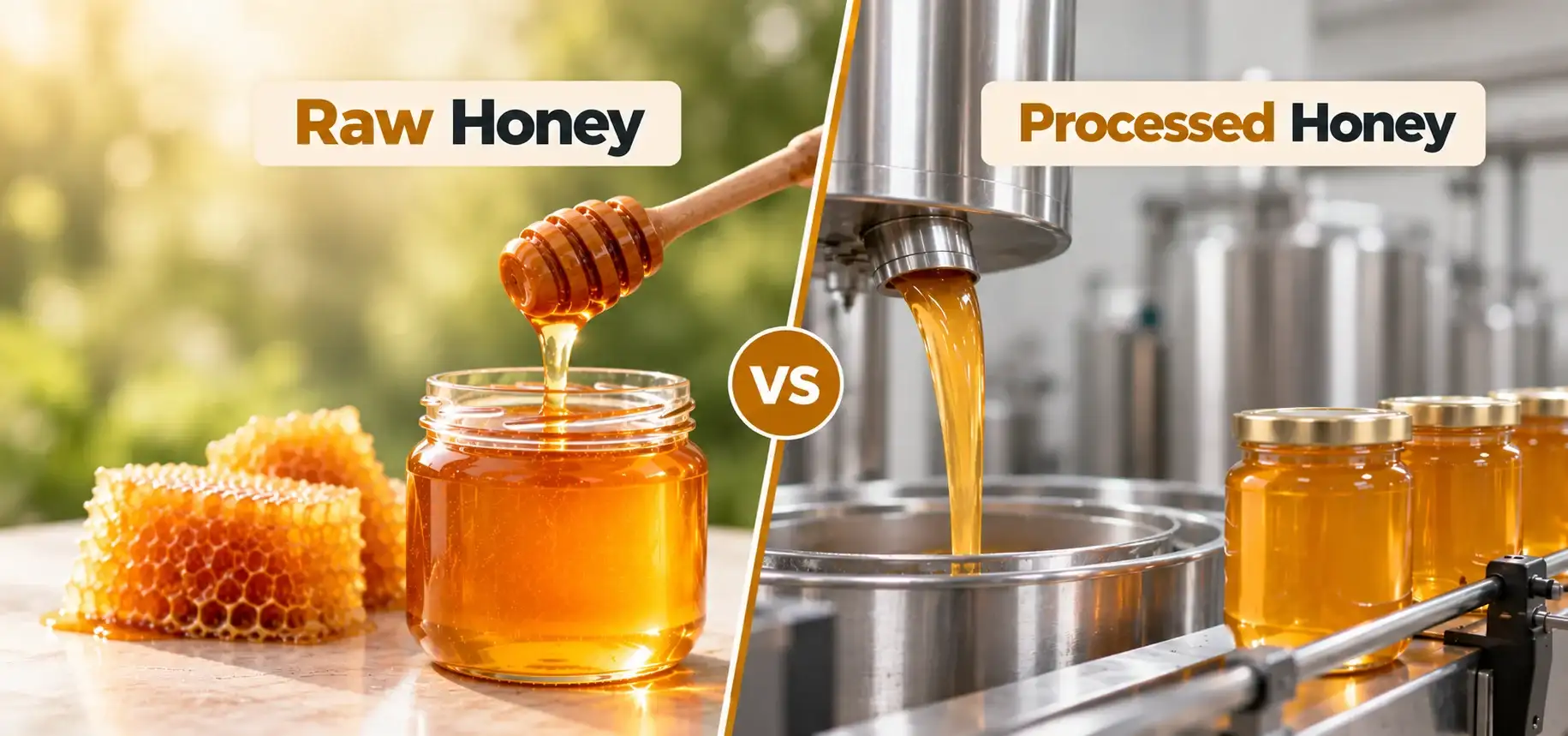
The majority of jars lining grocery store shelves contain processed honey. That’s a business decision, and it helps to understand what that decision costs.
What Commercial Processing Does
Commercial honey often comes from many hives, sometimes many countries, blended in large tanks. Two steps then change it:
- Pasteurization. The honey heating process typically takes it to around 145°F or higher, sometimes in a quick flash. This melts crystals, stops yeast from fermenting it, and keeps the jar liquid for months.
- Fine filtration. Warm honey is pushed through fine filters and comes out bright, clear, and nearly free of pollen.
Packers do this because shoppers like clear honey, and it bottles faster. The trade-off is real, though. Heat weakens natural enzymes like diastase and invertase. Heavy filtering removes the pollen that shows where the honey came from (pollen is basically honey’s fingerprint).
Side by Side
| Feature | Raw Honey | Processed Honey |
| Heat | None beyond hive warmth | Often 145°F or higher |
| Filtering | Coarse straining only | Fine or pressure filtered |
| Look | Cloudy, opaque or creamy | Clear and glassy |
| Crystallizes | Weeks to months | Slowly, stays liquid longer |
| Pollen and enzymes | Mostly intact | Largely reduced |
| Flavor | Changes with flower and season | Mild and uniform |
How Is Raw Honey Different From Ordinary Honey?
The biggest differences come down to flavor, texture, and what stays in the jar. Raw honey retains its pollen, wax specks, and active enzymes. Ordinary honey gives those up in exchange for clarity and a longer liquid shelf life.
On nutrition, be realistic. Raw honey does hold on to slightly more of its natural antioxidants. Both are mostly sugar (about 17 grams per tablespoon), with only small differences in vitamins and minerals. Choose raw for its taste and character, and enjoy either kind in sensible amounts.
Raw Honey Characteristics: Look, Smell and Taste
Your eyes, nose, and a spoon will tell you plenty. These are the raw honey characteristics a beekeeper checks first.
- Look: often cloudy or gently opaque. Hold it to the light, and you may spot tiny flecks of wax or pollen. A thin white foam on top is normal too… It’s just fine air bubbles.
- Smell: raw wildflower honey smells of blossoms, dry hay, sometimes warm caramel. Processed honey mostly smells sweet.
- Taste: flavor follows the flower. Clover is mild and buttery. Orange blossom is bright, almost citrusy. Buckwheat is dark and malty, close to molasses. Heat tends to smooth these notes into plain sweetness.
- Texture: thick and slow, with a pleasant graininess as it sets.
Crystals Are a Good Sign
Raw honey turns solid over time, and that’s not spoilage. Honey contains more sugar than its moisture can hold in solution, so glucose gradually separates and forms crystals. Pollen and wax specks give those crystals a place to start, which is why raw honey sets sooner.
To loosen it, stand the jar in warm (not hot) water and stir now and then. Skip the microwave.
Home Purity Tests Have Limits
Popular home checks you’ll find online include the water test, the thumb test, and the flame test. These methods are a fun starting point, though a lab test remains the definitive check. Thick processed honey can pass them, and real raw honey can fail. A lab test or a beekeeper you trust is the only real check.
What Does Raw Honey Mean on a Product Label?
On a US label, “raw” means whatever the seller says it means. That’s the honest answer.
The FDA has never established a legal standard of identity for honey. Its guidance on labeling honey addresses what gets added, like corn syrup, which must be named as a blend. Its scope covers what gets added, while heat and filtering are left to producer discretion. Labeling “raw” is handled by the producer, with federal oversight focused elsewhere in the labeling process.
A handful of states have stepped in. Utah passed a law in 2011 permitting the raw label only on honey that meets the state’s definition. Most states have no such rule.
Label Decoder
Here’s what the common words on a US honey jar actually promise, and what they don’t:
- Raw: the producer claims no heating or fine filtering. No federal verification.
- Unfiltered: strained rather than finely filtered, for a more natural texture. It may still have been heated.
- Pure or 100% Honey: nothing was added, keeping it simple. Pure honey can still be pasteurized and filtered.
- Natural: no artificial ingredients. Focuses on ingredients rather than processing.
- USDA Organic: a certified claim about how the hives are kept, not about heat.
- Grade A: a voluntary USDA grade for moisture, flavor, and defects. It doesn’t mean raw.
- Country of origin: a useful clue. One named source is easier to trace than a multi-country blend.
Safety Notes Before You Buy Raw Honey
Raw honey is a safe food for most adults. Most adults can enjoy raw honey freely, with a few simple precautions for certain groups.
Babies under 1 year: wait until their first birthday before introducing any kind of honey. Honey may harbor inactive Clostridium botulinum spores, which is why the first birthday is the recommended starting point. This applies to all honey, whether processed, baked into foods, or used on a pacifier. Pasteurizing doesn’t eliminate these spores, so any honey, raw or not, is best saved for after the first birthday.
Pollen or bee allergies: raw honey carries more pollen than filtered honey. If you’ve reacted to bee stings, bee pollen, or propolis, talk to your doctor first.
Weakened immune system: if your immunity is low from illness or treatment, check with your doctor before eating raw honey.
Using Raw Honey as a Base for Functional Blends
For centuries, cultures across Asia and the Middle East have turned to honey as a carrier… a pleasant way to take bitter roots and rare hive products. Gently handled honey suits that role well, because its own character stays intact.
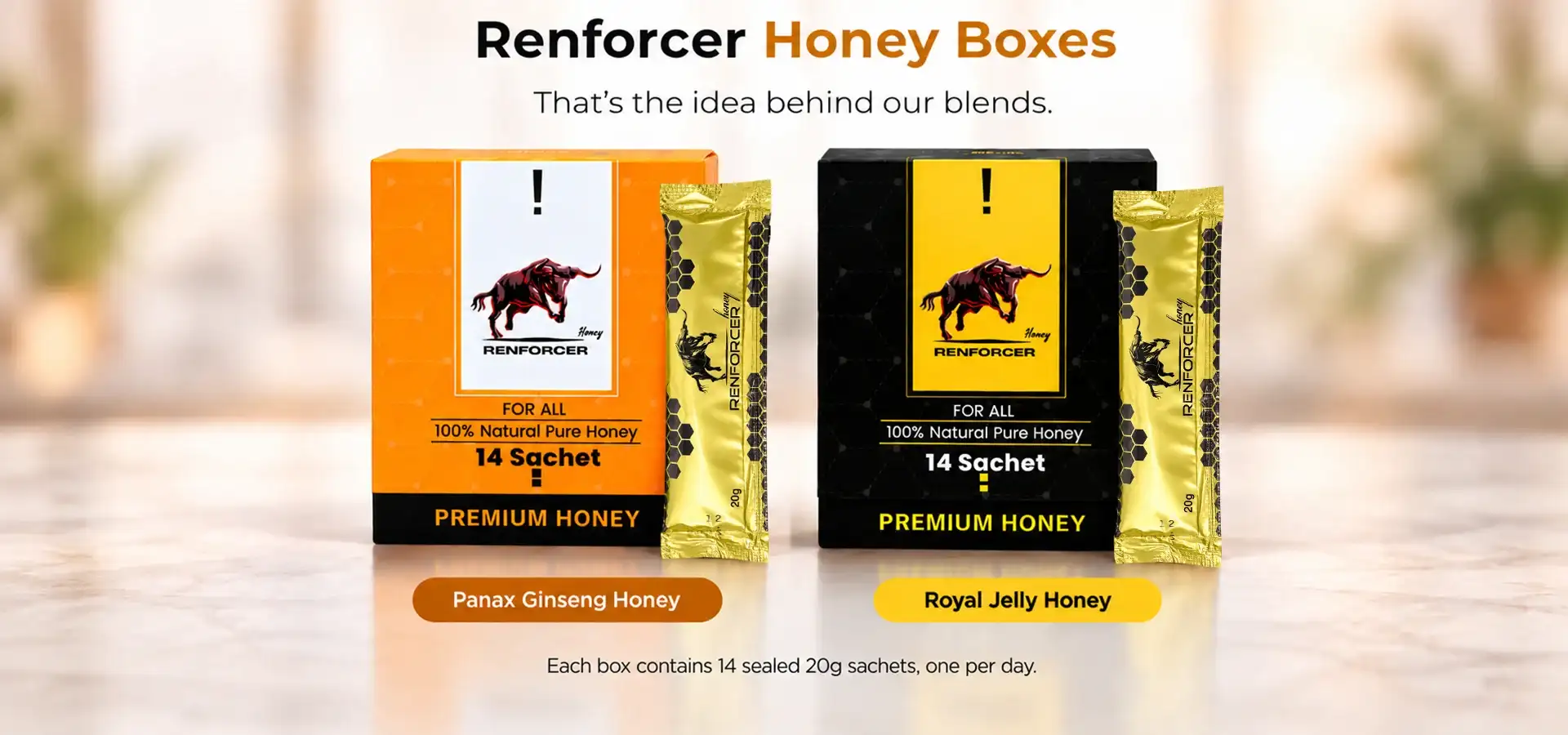
That’s the idea behind our blends.
- The RENFORCER Panax Ginseng Honey combines pure honey with finely ground Panax ginseng root, adding a warm, earthy note.
- The RENFORCER Royal Jelly Honey Stamina Box begins with a raw honey base and adds royal jelly for a rounder, creamier body with a faint tang.
Each box contains 14 sealed 20g sachets, one per day.
One practical tip: don’t stir honey into a drink that’s still boiling. Let it cool for a minute so the heat doesn’t flatten the flavor. Both blends are for adults only.
FAQs
Is raw honey the same as unfiltered honey?
Not exactly. Unfiltered means the honey wasn’t finely filtered, though it may still have been heated; check with the seller for details. Raw honey should be both unheated and only strained. Look for both words on the label, or ask the seller.
Is “pure honey” raw honey?
No. “Pure” means nothing was added. Pure honey can still be pasteurized and filtered clear. All raw honey is pure, but not all pure honey is raw.
Why does raw honey turn solid?
That’s crystallization, and it’s natural. Glucose separates and forms crystals, usually sooner in raw honey. Placing the jar in warm water restores it to a liquid state.
Can you warm raw honey and keep it raw?
Gentle warmth near hive temperature (about 95°F) changes very little. Hot water, the stove, or the microwave will. Keep it low and slow.
Does raw honey go bad?
When kept sealed and stored properly, honey lasts for years. Its low water content and natural acidity hold back most microbes. If it smells sour or starts to bubble, it has likely picked up moisture and begun to ferment, a good sign to start a fresh jar.
The Bottom Line on What Raw Honey Means
So, what does raw honey mean? It’s honey taken from the comb, strained, settled, and jarred… with no added heat and no fine filtering. It looks cloudier, sets sooner, and tastes more of the flowers behind it.
Let the label be a clue, not the conclusion. Know your source, ask how the honey was handled, and trust a beekeeper who answers plainly. For the full picture from hive to table, read our guide to raw honey.