
Raw honey vs. regular honey is mostly a difference in heat. The raw jar takes a short route: out of the comb, through a strainer, and into the jar, with no extra heat added along the way. The other gets warmed, finely filtered, and often pasteurized until it pours clear and stays liquid for months.
And because “raw” has no federal definition in the US, the back label and the producer’s methods tell you the most.
Raw Honey vs. Regular Honey at a Glance
| Feature | Raw honey | Regular (commercial) honey |
| Added heat | None beyond hive warmth (about 90 to 95°F) | Warmed for bottling; often pasteurized |
| Filtration | Strained through coarse mesh | Finely filtered or ultrafiltered |
| Pollen and wax specks | Small amounts stay | Mostly removed |
| Look | Cloudy, sometimes with a thin white top layer | Clear and glossy |
| Consistency | Thick; often sets grainy or solid | Smooth and pourable for months |
| Flavor | Tracks the flower and season | Mild and uniform, often a blend |
| Heat-sensitive enzymes | Largely intact | Reduced |
| Calories per tablespoon | About 64 | About 64 |
| Safe for babies under 1? | No | No |
Heat is the biggest difference between raw and regular honey.
What Is Raw Honey?
Raw honey is harvested by spinning it from the comb, then strained and jarred as it is, with no heat applied. Before harvest, bees ripen the nectar and seal it under beeswax, a stage our complete raw honey guide walks through step by step.
When harvest comes, a beekeeper slices the wax cappings off each frame, and an extractor spins the honey out. Next, a mesh or nylon-cloth strainer catches the big bits, with openings of about 800 to 1,000 microns. Pollen grains measure roughly 10 to 50 microns… so most pollen slips through, and only wax and debris stay behind.
The National Honey Board’s definition (honey as it sits in the hive, or extracted, settled or strained without added heat) carries no legal weight. Utah, for one, bars pasteurized honey from the raw label.
What Is Regular Honey?
Regular honey, also called commercial honey, is the clear, pourable kind on most grocery shelves. It follows a longer, more hands-on path:
- Warming: honey at 120°F moves through bottling lines far faster than at 100°F or lower.
- Pasteurization: holding honey at 145°F for 30 minutes, or 160°F for about a minute, kills the wild yeasts behind fermentation. It also melts any crystals.
- Fine filtering: honey has to be warm to pass a tight filter, and ultrafiltration strips it down further for that glassy look.
- Blending: the US imports more than 70% of the honey it consumes, and big brands often blend sources so each bottle tastes the same year after year.
Once the plastic honey bear arrived in the 1950s, honey kept doing what it does naturally inside the squeeze bottles: forming crystals. By the 1960s, packers were heating and filtering it until you could read a newspaper through the jar.
What Are the Main Differences Between Raw and Regular Honey?
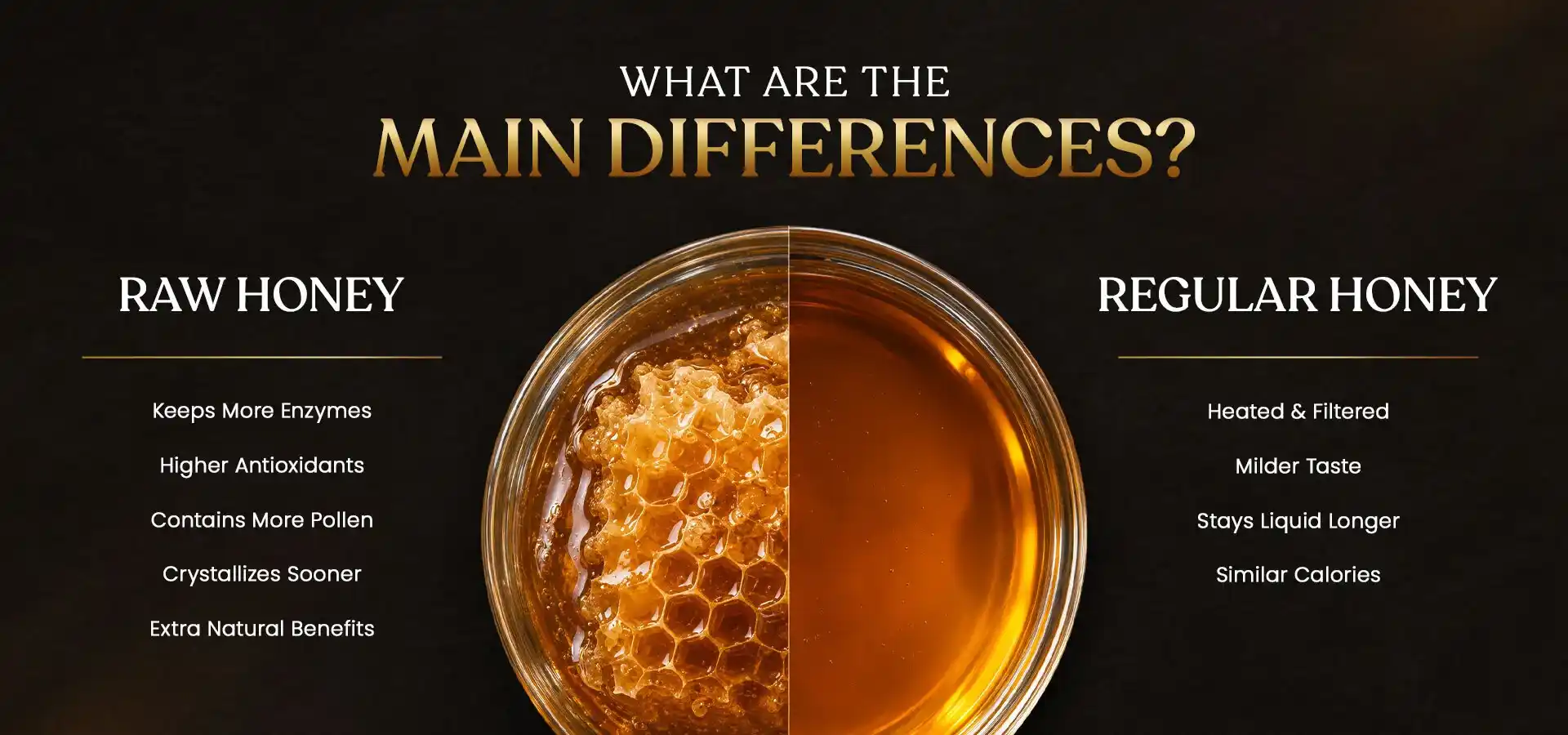
Up to extraction, all honey processing methods look about the same. The raw vs. regular honey split happens at the heater and the filter, so the difference between raw and regular honey really comes down to those two steps.
Raw Honey Keeps More of Its Enzymes
Diastase is an enzyme bees add to nectar, and it loses half its activity in:
- about 1,000 days at 68°F
- roughly 14 days at 122°F
- about 30 seconds at 176°F
Glucose oxidase weakens with heat too.
Raw Honey Often Keeps More Antioxidants
In a 2019 lab study published in Heliyon, researchers held three honeys at 145°F for up to 30 minutes. By the 30-minute mark, phenolic compounds (polyphenol antioxidants that counter free radicals) had dropped by about 13% to 21%. HMF, a compound that builds as honey ages or heats, rose 81% to 108% but stayed under the 40 mg/kg trade limit. Antioxidant scores fell clearly in the thyme honey, partly in the lotus honey, and held steady in the mixed-flower honey.
Even so, some lab work finds antioxidant readings rise after heating, since browning reactions create new compounds.
Raw Honey Contains More Pollen
The USDA’s voluntary grading standards for extracted honey name two styles, or honey filtration levels:
- Strained honey sheds bits of comb and propolis (bee glue) but usually keeps its pollen grains, tiny air bubbles, and very fine particles.
- Filtered honey trades those details away for a glassy, uniform look, pollen included.
Pollen works like a fingerprint too. Labs read it to confirm where honey came from (a method called melissopalynology), so filtering it out erases the trail.
Regular Honey Tastes Milder
Taste regular honey vs. raw honey side by side, and the honey flavor differences show up fast. A raw single-flower (monofloral) honey tastes like its plant:
- Buckwheat: dark and malty, close to molasses
- Sourwood: sweet and spicy, finishing with a faint whisper of anise
Commercial honey tastes milder on purpose. Blending evens out the flavor, and heat speeds the loss of aroma.
Raw Honey Crystallizes Sooner
A grainy jar is not spoiled. Crystallization happens because honey holds more sugar than its water can keep dissolved, so glucose slowly drops out as crystals. Raw honey compared to regular honey sets sooner, because specks of pollen and wax (plus tiny air bubbles) give crystals a place to start.
Then there’s the flower. High-glucose honeys like clover and canola crystallize fast, while tupelo and black locust, both high in fructose, can stay liquid for years.
Temperature shapes honey consistency too:
- Around 57°F, crystals form fastest, and the fridge speeds them along.
- At 32°F or below, honey won’t crystallize.
- At about 100 to 104°F, it turns liquid again.
Calories and Sugar Stay the Same
A tablespoon of either holds about 64 calories and 17 grams of sugar. Judged on sugar alone, raw honey vs. regular honey is a tie.
Health Benefits of Raw Honey
Most research tests honey in general, not raw honey alone. Raw honey’s edge is more of the heat-sensitive parts above, plus trace bee pollen. Its glucose oxidase slowly releases hydrogen peroxide, part of why honey resists germs. Raw honey may also carry friendly microbes like Lactobacillus and Bifidobacteria, both found in the human gut.
That said, there’s no solid evidence that local honey eases seasonal allergies (hay fever). Our raw honey benefits guide sorts what the research backs from what it doesn’t.
Risks of Eating Raw Honey
For most healthy adults, raw honey poses little risk. Two things are still worth knowing before you dig in.
Botulism in Babies
Honey can carry Clostridium botulinum, the bacteria behind infant botulism, and its spores can survive pasteurizing heat. That’s why the CDC says never to give honey to a child younger than 1 year, pasteurized honey included. Save the jar for the grown-ups until then.
Allergies and Weak Immunity
Raw honey holds a larger share of pollen and live microorganisms. A small number of people with bee-product allergies have had severe reactions, including anaphylaxis, so a quick word with your doctor is a smart first step, especially if you have a weakened immune system.
Raw, Pure, Natural or Organic: What the Labels Mean
Four words on the label do most of the selling. Here’s what each one covers.
- “Raw” has no federal definition, so look for “unheated” or “unpasteurized” next to it.
- “Pure” or “100% honey” tells you the jar holds honey and nothing else. Under FDA rules, honey mixed with another sweetener must be sold as a “blend.”
- “Natural” has no formal definition. The FDA’s long-standing policy reads it as nothing synthetic added, a bar any honey clears.
- “Organic” covers where bees forage (away from pesticides) and how hives are managed. It isn’t a processing claim, so organic honey can still go through a pasteurizer.
Buy from a producer you trust, and this stops being a worry, since a small share of honey is blended with cane or corn syrup, a practice called economically motivated adulteration. The FDA’s own testing found: In 2025 honey testing, only about 4% of 102 samples, domestic and imported alike, held undeclared sweeteners, so most jars tested clean. An earlier round of imported honey (2021 to 2022) came in at 10%.
The FDA notes that its testing rounds weren’t designed for statistical comparison. Its labs use carbon isotope testing, a solid screen that catches many syrups, though no single test catches every one. So the surest move is to judge the producer rather than run kitchen tests.
How to Store Raw and Regular Honey
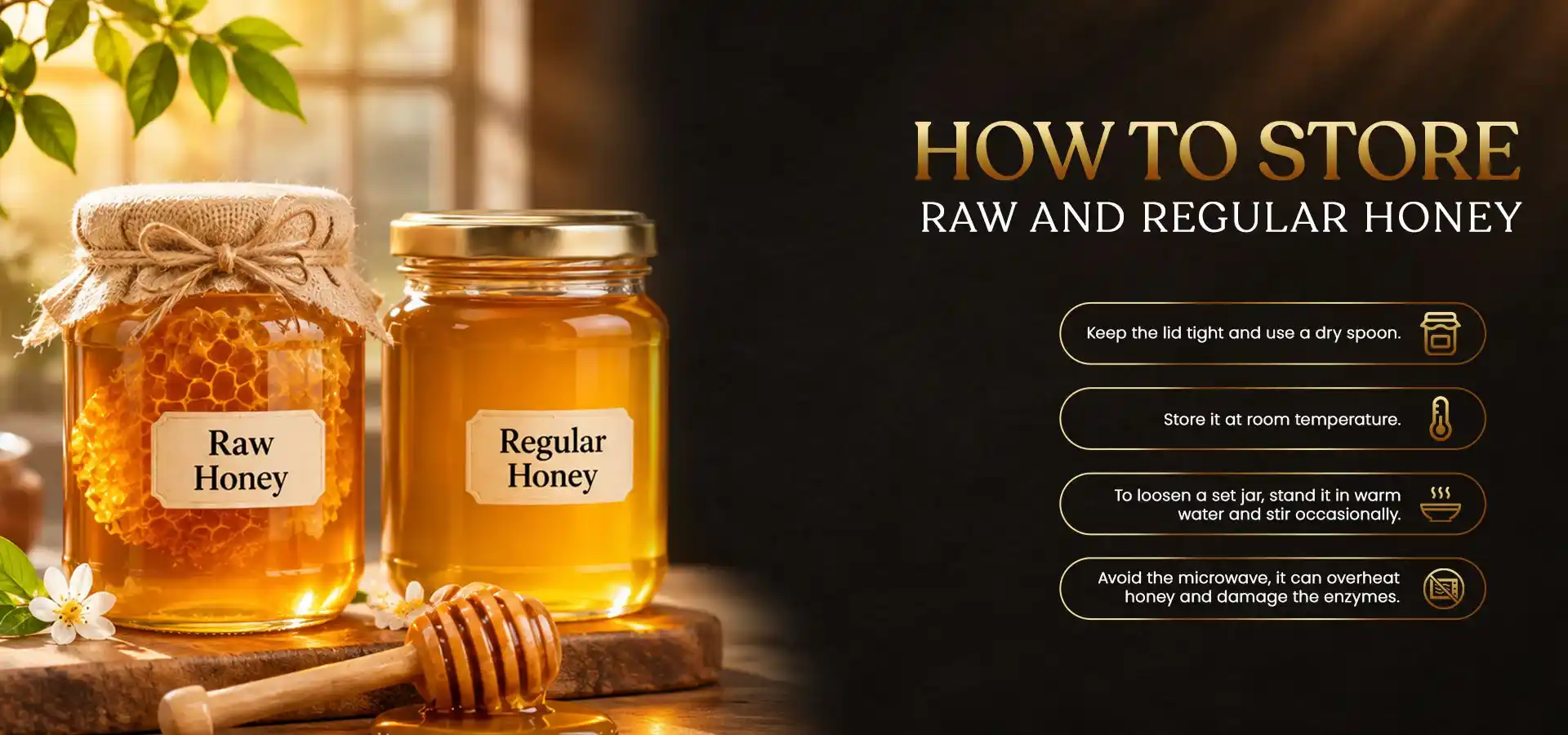
Good honey handling and storage comes down to water. Honey stays good for years when kept sealed and dry. But it pulls moisture from damp air, and raw honey carries wild yeasts that can ferment it once moisture tops roughly 18 to 19%. Two situations call for a little extra care:
- A set jar, since forming crystals leave extra water behind
- An open jar, even a pasteurized one, since fresh air brings yeast with it, so a tight lid does a lot of work
To keep a jar in good shape:
- Keep the lid tight and use a dry spoon.
- Store it at room temperature.
- To loosen a set jar, stand it in warm water and stir now and then, which does the job nicely. The microwave, by contrast, can overheat honey in spots and damage the enzymes.
A thin white top layer on raw honey is usually trapped air and wax. A sour, boozy, or fizzy smell means fermentation has started.
Which Honey Should You Buy?
Match the honey to the job: For baking and barbecue glazes, commercial honey makes sense, since oven heat runs far past the point where enzymes last. For anything you eat as is, raw honey earns its price. Think yogurt, warm toast, a cheese board, or tea that has cooled for a minute.
That cooling minute is also why our Renforcer sachet directions tell you to let a hot drink settle before stirring one in. If you are looking for premium honey, here are our two honey boxes:
- The Royal Jelly Honey Stamina Box pairs pure raw honey with royal jelly.
- The Panax Ginseng Honey blends pure honey with finely ground Panax ginseng root.
Each box holds 14 sealed 20 g sachets, made for adults 18 and up.
FAQ’s
Is raw honey better than regular honey?
For eating straight from the spoon, usually yes. It holds more pollen, enzymes, and aroma. In baking, that edge cooks away, and the calories match either way.
Does unfiltered honey mean the same as raw honey?
Not always. “Unfiltered” covers the filter step only, so a jar can skip fine filtering and still get plenty of heat.
Why does raw honey cost more?
Bottling honey without heat is a slower, more hands-on job, and that extra care shows up in the price.
Final Thoughts: What to Check on Your Next Jar
At the store, the back label answers the raw honey vs. regular honey question better than the front. Check four things:
- A named producer and region, or at least a country of origin (US rules make imported honey list it).
- Processing words beyond “raw,” like “unheated,” “unpasteurized,” or “strained.”
- A texture that fits the season. Raw honey in January is usually grainy or set, unless it’s a slow variety like tupelo.
- Honey as the only ingredient, with no “blend” in the name.
Buying directly from a beekeeper? Find out how much heat the honey sees before it goes into the jar. A careful producer will answer with a number, ideally 104°F or less, a line many beekeepers won’t cross.