
Raw honey benefits come from what it keeps. Because it’s only strained, never heated, raw honey holds onto natural enzymes, bee pollen, propolis, and antioxidants that pasteurization tends to strip out. Research links honey to cough relief, antioxidant protection, and modest gains in cholesterol and blood sugar.
The sugar is the same as regular honey, though… so the benefits show up when it replaces sugar, not when it’s added on top.
Raw honey nutritional value, by the spoonful
One level tablespoon (21 g) of honey, per USDA FoodData Central:
- Calories: 64
- Total sugars: 17.2 g
- Fructose: 8.6 g
- Glucose: 7.5 g
- Small amounts of potassium, calcium, magnesium, phosphorus, zinc, manganese, riboflavin, niacin, and pantothenic acid (the exact mix varies with the flowers the bees worked)
So honey composition is mostly natural sugars in honey (fructose and glucose), plus about 17% water. Just over half the sugar is fructose, which gives pure honey a medium glycemic index of about 60. The vitamins and minerals are too small to matter for daily needs.
The raw honey nutrients worth caring about are its 180+ minor compounds, from polyphenols and amino acids to enzymes. Those are exactly what heat and heavy filtering damage first.
Raw honey compared to regular honey
What is the nutritional difference between raw and processed honey? On the macro level, almost none. Where they part ways is in the fragile stuff, and it all comes down to how the honey is handled after the hive (our guide on what raw honey is walks through that process step by step).
| Raw honey | Regular (processed) honey |
| Not heated beyond hive warmth | Usually pasteurized |
| Coarse strained only | Fine filtered or ultrafiltered |
| Keeps traces of bee pollen | Pollen often removed |
| Enzymes (diastase, invertase, glucose oxidase) intact | Enzymes reduced by heat |
| Higher in polyphenols and antioxidants | Some antioxidants lost in processing |
| About 64 kcal and 17 g sugar per tbsp | About 64 kcal and 17 g sugar per tbsp |
| Thick, cloudy, crystallizes sooner | Clear, stays liquid longer |
Heat decides most of it. In lab tests, honey enzymes held steady at 104°F (40°C), but at 140°F (60°C) and above, diastase activity dropped while HMF (a heat by-product) climbed. Heating also cuts flavonoids like kaempferol and galangin, and fine filtering lowers vitamin content by stripping out pollen.
Purity matters too. Researchers estimate about 1 in 10 jars of honey worldwide is cut with cheaper syrups. Honey from hives near industrial areas can also pick up heavy metals like lead and cadmium, so a traceable producer is worth paying for.
9 Potential benefits of raw honey, checked against the evidence
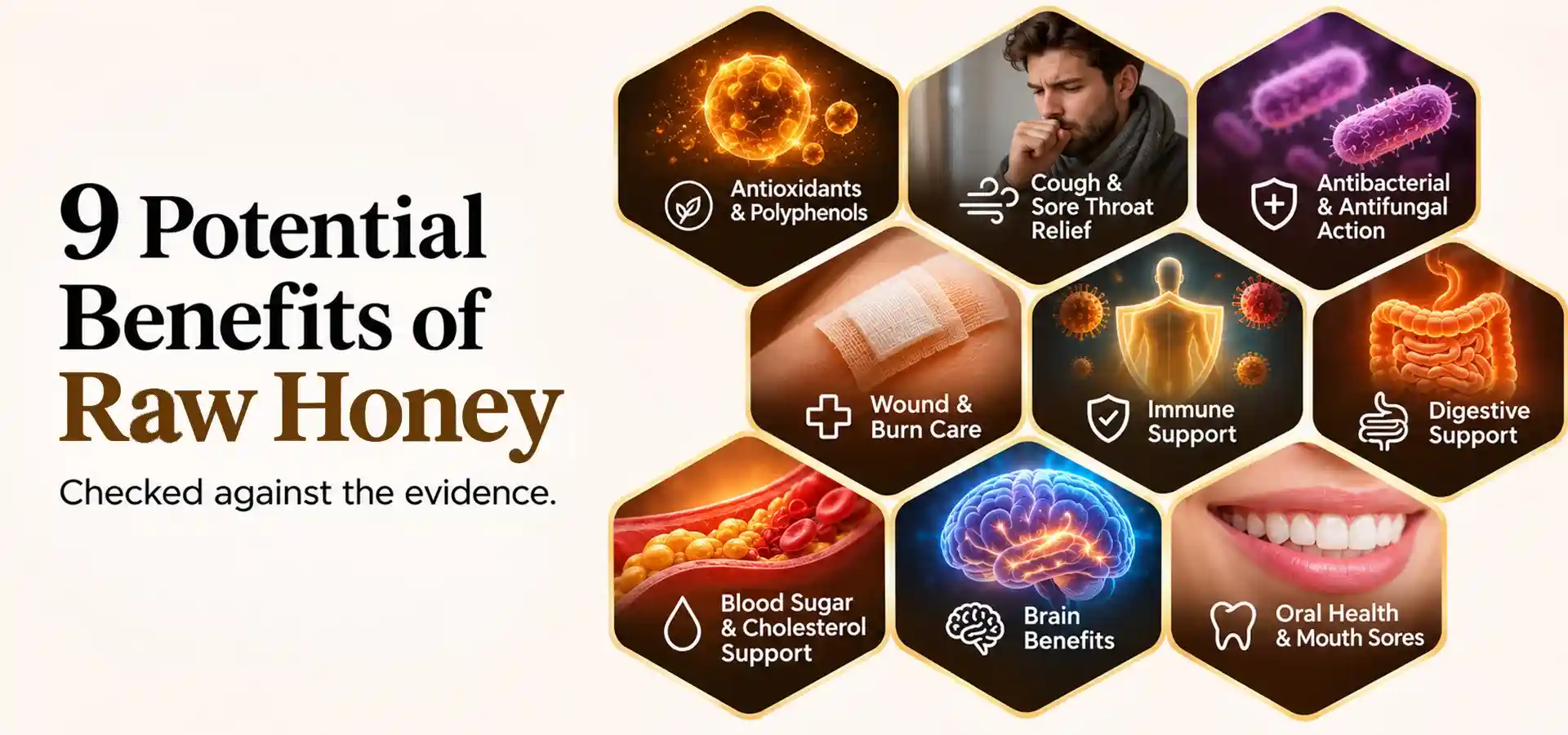
Most studies test honey in general, not raw honey alone. Raw likely holds a slight edge where enzymes and polyphenols are involved.
1. Antioxidants and honey polyphenols
Most of honey’s antioxidant punch comes from its polyphenols, mainly phenolic acids and flavonoids. They mop up free radicals, the unstable molecules that wear cells down over time (what researchers call oxidative stress). These are phytonutrients, compounds plants make to guard against insects and UV light, and bees carry them from nectar into the jar. They drive much of honey’s antioxidant and antibacterial power.
Color is a handy guide. Dark buckwheat honey (malty, almost molasses-like) usually tests higher than pale clover or acacia. And since heat breaks these compounds down, raw honey keeps more of what the flowers put in. This holds up in people too: a 2023 review of 48 human trials found buckwheat honey raised antioxidant levels in the blood of healthy adults.
2. Cough and sore throat relief
Of everything here, cough relief has the most solid research behind it. A Cochrane review of six trials covering 899 children (ages 1 to 18) found honey probably eases coughing better than a placebo, and about as well as dextromethorphan, a common over-the-counter cough ingredient.
Most kids took it for only one or two nights, and the evidence was rated low to moderate. Still, a spoonful before bed is a sensible first step for a nagging cough (and it coats a scratchy throat on contact). Trials also link it to better sleep during a cough, for kids and parents alike.
3. Antibacterial and antifungal action
Raw honey fights microbes on several fronts. Its low water content and dense sugar pull moisture out of bacterial cells. Its pH runs between about 3.2 and 4.5, acidic enough to slow their growth. And the enzyme glucose oxidase turns a little glucose into hydrogen peroxide whenever honey meets moisture.
Heat weakens glucose oxidase, so raw honey holds a clear edge here. Manuka honey from New Zealand adds methylglyoxal (its UMF grade tracks the strength), and in lab tests it has stopped E. coli, Staphylococcus aureus, and H. pylori, the bacteria behind many stomach ulcers.
The same properties reach some fungi and yeasts in the lab. Most of this comes from test tubes, though, so it doesn’t mean eating honey will clear an infection.
4. Wound and burn care
That antibacterial mix is the reason honey has dressed wounds for thousands of years. Modern hospitals still use it on burns, ulcers, and slow-healing skin because it keeps the wound moist while it holds bacteria back. In clinical trials, honey dressings have even helped shrink diabetic foot ulcers.
But clinics use sterile, medical-grade honey. Pantry honey isn’t sterile and can carry spores, so keep it off cuts and burns.
5. Immune support
Raw honey’s antioxidants help keep oxidative stress in check, and its propolis and bee pollen show antibacterial and antiviral activity in lab research. Honey itself has also acted against influenza and herpes simplex viruses in the lab. Still, no solid human trials show that daily honey keeps colds or flu away. Its real role in cold season is symptom relief.
6. Digestive support
Honey contains small amounts of oligosaccharides, complex sugars that can slip past digestion and reach the colon. A 2022 review in Frontiers in Nutrition found that these compounds fed beneficial bacteria like Bifidobacterium and Lactobacillus in lab and animal studies. Honey also helped probiotic bacteria survive digestion in lab tests.
The one human trial in that review (20 g a day) saw no major shift, so call it promising, not proven. Early research in children also suggests honey given with zinc may shorten diarrhea, and other trials found it sped up recovery from bacterial gastroenteritis. Just go easy: 50 to 100 g at once can act as a laxative.
7. Blood sugar and cholesterol
A University of Toronto analysis pooled 18 trials with over 1,100 people. About 40 g of honey a day (two tablespoons) for roughly eight weeks was linked to lower fasting blood sugar, total and LDL cholesterol and triglycerides, plus higher HDL. Notably, the raw honey trials showed some of the clearest results.
Most of the evidence was rated low certainty, and the gains showed up when honey replaced table sugar or syrup in a healthy diet, not when it was added on top. The 2023 review of human trials saw similar shifts in adults with obesity, along with small drops in body weight, body fat, and CRP, a marker of inflammation. There may be a blood pressure angle too, though so far it shows up mostly in rats. It’s no stand-in for blood pressure medication.
8. Brain benefits
This is the newest corner of honey research, and most of it so far comes from lab animals. In those studies, honey has been linked to:
- Sharper memory in rats and mice
- Less oxidative damage to nerve cells, and calmer inflammation in the hippocampus (the part of the brain that handles memory)
- Signs of lower stress and a better mood
There’s an indirect link as well. The better blood sugar and cholesterol numbers seen in human trials ease metabolic syndrome, which is tied to a higher risk of Alzheimer’s disease. Still, nobody has shown yet that a spoonful of honey protects the human brain.
9. Oral health and mouth sores
In human trials, honey reduced dental plaque and Candida, the yeast behind oral thrush. For people getting radiation for head and neck cancer, honeys like manuka and thyme also eased painful mouth sores (mucositis). That’s supportive care alongside medical treatment, not a replacement for it.
Who should skip raw honey, or go easy
Babies under 12 months should never have honey, raw or processed. It can carry Clostridium botulinum spores that an infant’s gut can’t handle, and pasteurization doesn’t reliably kill them. That first-birthday rule comes straight from the CDC and the American Academy of Pediatrics.
Signs of infant botulism can include:
- Constipation
- Poor feeding
- Drooping eyelids
- A weak cry that sounds different than usual
- Less facial expression than usual
- Weak sucking or gag reflex
- A limp body or trouble holding the head up
In adults, it’s rare, but it can start with nausea, vomiting, or diarrhea, then bring blurred vision, drooping eyelids, slurred speech, and muscle weakness. Botulism is a medical emergency, so get care right away if these signs follow eating honey.
A few others should be careful:
- People with bee pollen or bee product allergies, since raw honey holds more pollen (reactions are rare but can be severe, up to anaphylaxis)
- People with weakened immune systems, who may be advised to stick with pasteurized honey
- Anyone managing diabetes, since honey still raises blood sugar
For everyone else, watch the portion. For added sugar, the American Heart Association’s daily limit lands around 36 g for men and 25 g for women. One level tablespoon of honey already carries about 17 g of sugar, close to half of what a woman should have in a day. That’s why we’d keep it between a teaspoon and a tablespoon daily.
How to choose a good raw honey
Start with the label. A quick read of the jar can save you from a bad buy:
- Look for “raw,” or ask the beekeeper. Without it, assume the jar was pasteurized.
- “Pure,” “natural,” or “clover honey” say nothing about heat.
- Check for both “raw” and “organic” if you want both, since USDA organic honey can still be pasteurized.
- Honey should be the only ingredient, with no high fructose corn syrup.
- Favor a named region, floral variety, or producer.
Then trust your senses. Good raw honey is thick, a little cloudy, and smells layered and floral, so pass on anything watery or foamy. Flavor hints at the source too… clover is mild and grassy-sweet, orange blossom bright and citrusy, buckwheat dark and malty.
How to store raw honey
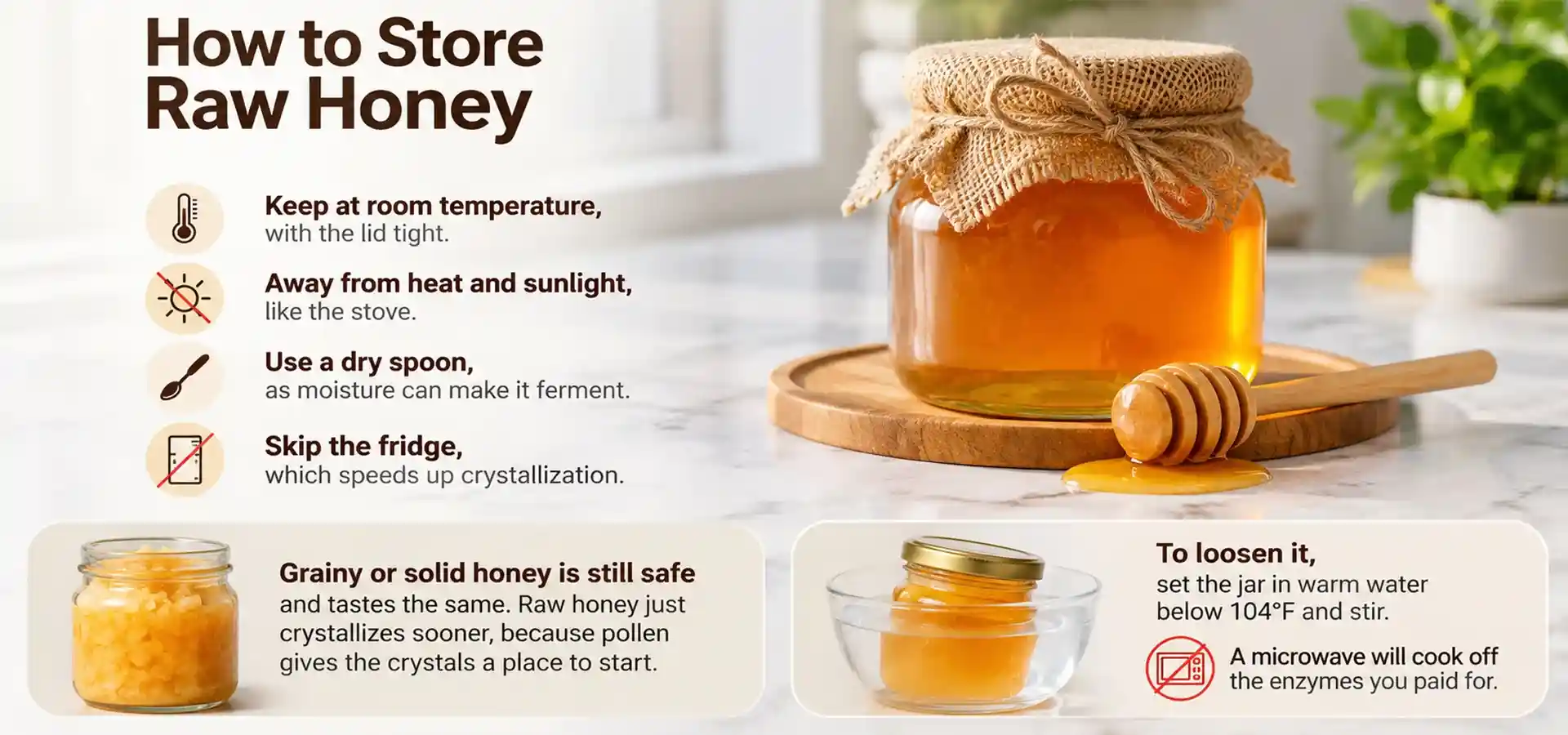
Store raw honey at room temperature with the lid tight, away from the stove and sun. Always use a dry spoon, since moisture can make it ferment, and skip the fridge, which speeds up crystallization.
Grainy or solid honey is still safe and tastes the same. Raw honey just crystallizes sooner, because pollen gives the crystals a place to start. To loosen it, set the jar in warm water below 104°F and stir. A microwave will cook off the enzymes you paid for.
Using raw honey day to day
Stir it into tea after it’s cooled to sipping temperature, not while it’s boiling. Drizzle it on plain yogurt or oatmeal in place of sugar. That swap is where the research found the clearest results.
Want honey that does a little more? Two RENFORCER blends build on the same base:
- Panax Ginseng Honey: honey blended with ginseng root, a botanical with a long history in traditional use
- Royal Jelly Honey Stamina Box: honey paired with royal jelly, the rich secretion worker bees make to feed their queen, in single-serve sachets
Whichever jar you choose, the raw honey benefits hold up best when you treat honey as a smarter swap for sugar… a spoonful at a time.
FAQ’s
What are the potential benefits of raw honey?
Cough relief and antioxidant intake have the best backing. Early research also points to modest gains in cholesterol and blood sugar when honey replaces refined sugar.
Is raw honey healthier than regular honey?
Slightly. Calories and sugar are the same, but raw honey keeps more enzymes, pollen, and polyphenols because it skips heat treatment.
How much raw honey should you eat a day?
For most adults, 1 teaspoon to 1 tablespoon a day is a sensible range. Count it toward your added sugar limit (about 25 g for women and 36 g for men).
Is raw honey safe for kids?
Yes, for children over 12 months. Never give any honey, raw or pasteurized, to a baby under 1 because of the risk of infant botulism.
Can people with diabetes eat raw honey?
Yes, in small amounts, but it isn’t a free pass. Raw honey lands in the medium range on the glycemic index (around 60), so a spoonful will still lift your glucose. If you have diabetes, count it like any other sugar and ask your doctor how it fits your plan.
Does raw honey go bad?
Kept sealed and dry, raw honey lasts a very long time. Moisture can make it ferment, but crystallizing is normal and doesn’t mean it has spoiled.
Does local raw honey help with seasonal allergies?
It’s a popular belief, but no solid evidence supports it yet.
Final Thoughts: Is raw honey worth it?
For most adults, yes, as long as it replaces sugar instead of adding to it. Raw honey benefits come from what heat would otherwise destroy: naturally occurring enzymes, polyphenols, pollen, and propolis. The strongest evidence backs it for coughs and antioxidant intake, with promising early data on cholesterol, blood sugar, and gut health. Pick labeled raw from a traceable source, keep it to a spoonful or so a day, and never give it to a baby under one.